Tell your friends about this item:
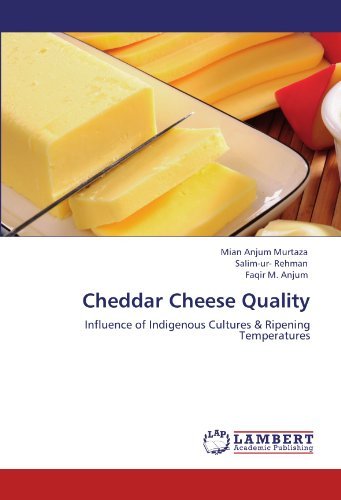
Cheddar Cheese Quality: Influence of Indigenous Cultures & Ripening Temperatures Faqir M. Anjum
Ordered from remote warehouse
Our customers say:


Cheddar Cheese Quality: Influence of Indigenous Cultures & Ripening Temperatures
Faqir M. Anjum
Cheddar cheese quality is influenced by starter cultures and milk composition. Most suitable and widely used starter cultures for Cheddar cheese manufacturing are Lactococcus lactis ssp. cremoris and Lactococcus lactis ssp. lactis. Cheddar is ripened for two months to a year or more. During ripening, microbiological and biochemical changes occur that result in the development of flavor and texture characteristics. These changes are grouped into glycolysis, proteolysis and lipolysis. Ripening is relatively an expensive process and reducing time without destroying the cheese quality has economic and technological benefits. Since the ripening temperature influences the rate of biochemical processes, the elevated temperature is the simplest method for accelerating the cheese ripening. Worldwide, the major portion of Cheddar is produced from cow milk. However, buffalo milk accounts about 80% of total milk produced in Pakistan and is rich in all the constituents especially lactose, caseins and calcium as compared to cow. Hence in present investigation, Cheddar cheese was manufactured from buffalo milk using locally developed (indigenous) cultures.
| Media | Books Paperback Book (Book with soft cover and glued back) |
| Released | September 27, 2011 |
| ISBN13 | 9783844383515 |
| Publishers | LAP LAMBERT Academic Publishing |
| Pages | 236 |
| Dimensions | 150 × 14 × 226 mm · 369 g |
| Language | German |